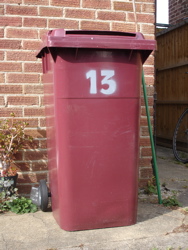
T’other day my friends at the Council were kind enough to arrange for a brand spanking new recycling wheelie bin in a tasteful corporate shade of plum to be delivered to me.
Loyal citizen that I am, I treasured the bin and took it to my heart – well, to the back door. I filled it with papery, plasticky stuff I didn’t want any more and anxiously awaited the next recycling day, when the bin would have its first emptying. All went according to plan and my pleasure was complete until after the bin was emptied. I wasn’t there to grab it from the kerb and wheel it back to the safety of my back door, and shock! Before I could retrieve it, it was wheeled away by somebody else!
Luckily for me the culprit was not a bin thief – it was the neighbours doing me the favour of taking the bin back to their garden gate, from where it was easy for me to lead it to its rightful home. Chastened by the memory of the emotional torment I suffered while believing that my bin had been taken from me, and knowing that it is bloody difficult to get a replacement, I resolved there and then to mark my bin with its house number, so there would be no question over where it belonged. Although some bins are now being fitted with advanced sensing and remote detection apparatus, I lacked the knowledge to apply such a technique. But I had a spraycan.
What would be a suitable approach to this lettering work? An eminent typographer has drawn attention to the variable quality of numbers applied to bins, with a particular focus on the Reading conurbation. I needed to uphold my typographic credentials, so this is what I did. You can read along too, and find out how to number your bin like a pro.
What you need
- a roll of sticky-backed plastic tape
- a craft knife
- a writing implement
- one sheet of writing/drawing paper (I used A4 size copier paper)
- one sheet of newspaper
- a cleaning cloth moistened with a 1:100 preparation of washing up liquid and water
- a wheelie bin (injection-moulded under a wandering star)
What to do
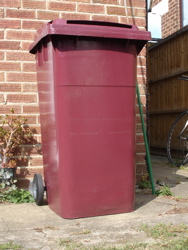
- Step 0: the bin, before operations commenced.
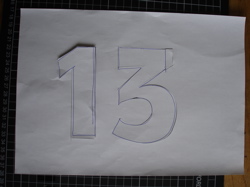
- Step 1: draw out the numbers. I used an A4 sheet of paper which was in the recycling pile as the basis of my stencil and an Icom Electronics promotional biro as my writing implement. Oh, and remember the camera never lies: I took this photo before I had cut out the numbers. That’s what forward planning is all about.
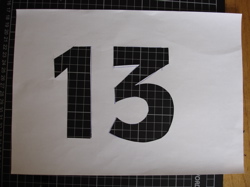
- Step 2: cut the numbers out of the stencil with a knife. I used a Stanley knife, which was a bit clumsy but did the job.
- Step 3: test the stencil. I sprayed through it onto the middle of a sheet of newspaper, then I cut the bit that I had sprayed out of the newspaper and taped the stencil over it. That made a larger mask to stop the spraypaint going over the edge of the stencil.
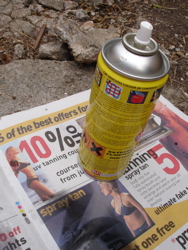
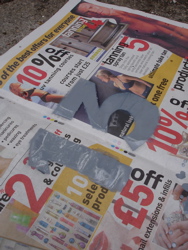
- Step 4: prepare the bin. Lie it flat, don’t try to work on a bin that’s standing upright. I thought the plastic would take the paint better if I cleaned it with a bit of washing up liquid. You don’t have to use an eco-friendly preparation with Aloe Vera but hey, it’s in the right spirit. Afterwards I dried off the bit I had cleaned.
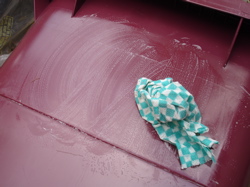
- Step 5: stick the stencil to the bin. I didn’t do this well enough — I thought lying the stencil flat on the surface would create an adequate mask to stop paint going where it wasn’t meant to go. In fact I think I should have damped the stencil with some water to seal the edges (the water would stick the paper to the plastic and also repel the oil paint). Lying the bin down ensures that the paint won’t dribble down and ruin the numerals.
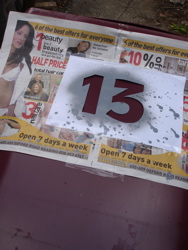
- Step 6: the environmentally-friendly bit. Spray a nice thick layer of paint on. I sprayed a bit too much, but hey. And note that I put an extra cloth down to catch the over-spray that fell outside the piece of newspaper that was intended to catch the over-spray. This was a sensible thing to do.
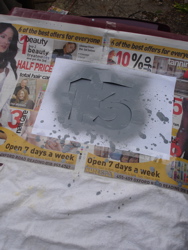
- Step 7: leave the artwork to dry for an hour or so, with the mask still in place (you can see I scraped away some of the excess paint while it was still wet, can’t you?), and…
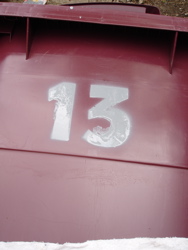
- … hey presto! Newly numbered bin shows off its tag.